Five Ways YouTube SEO Quietly Stops Working
For about a year I thought YouTube SEO was an arithmetic problem. More keywords in the title. A longer description with the phrase repeated in a few useful places. Tags until the box refused to accept any more.
The videos got a few dozen views each. Click rate was poor, almost nothing was recommended, and my conclusion at the time was that the algorithm was simply hard to please. It was not the algorithm. I was optimising for a machine, and the entity deciding whether to open the video was a person.
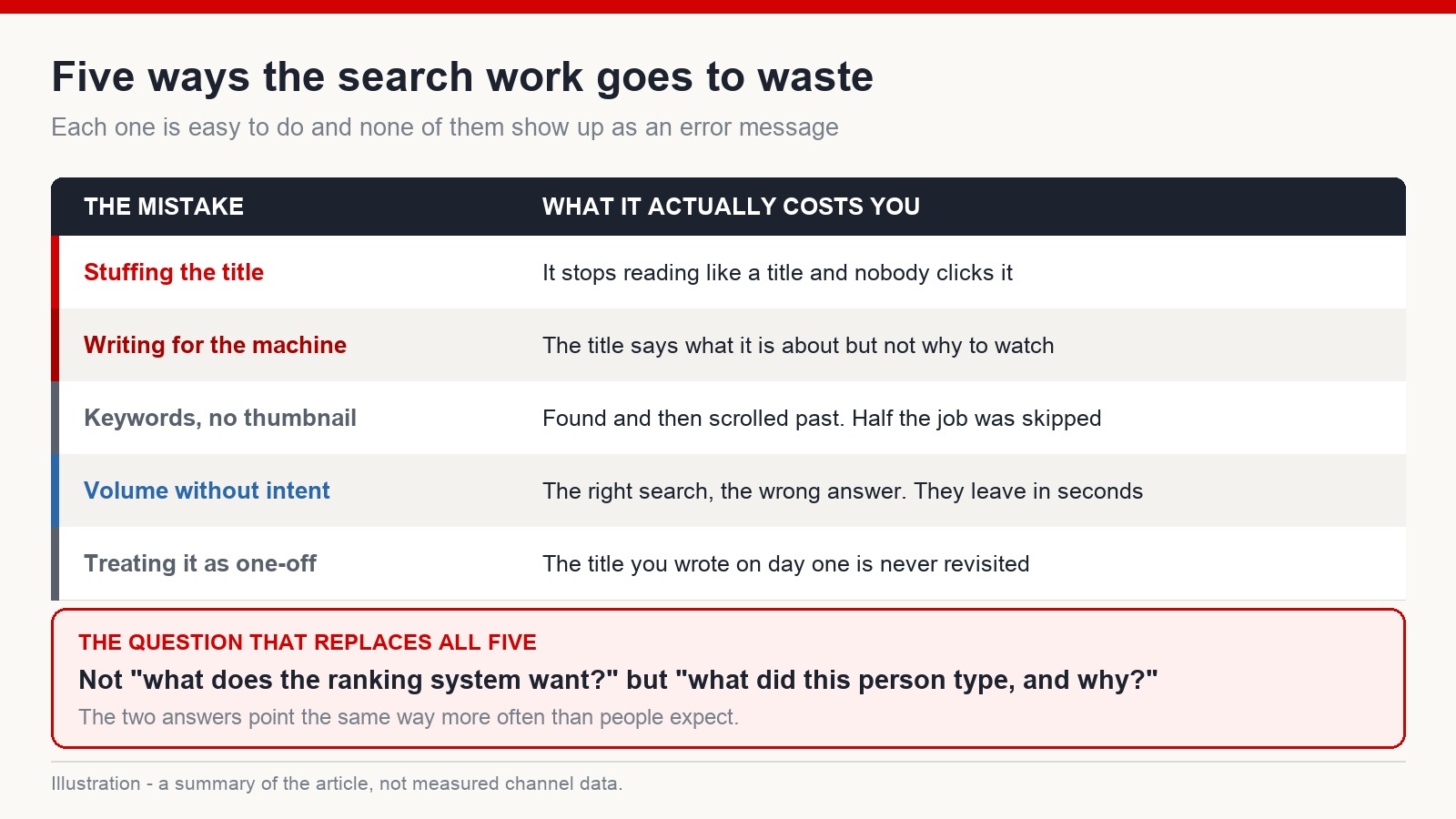
I have been making YouTube content since 2017, mostly faceless channels aimed at viewers in the US, the UK, Germany and Japan. These are the five mistakes I made, in the order they cost me the most – and none of them produce any kind of warning.
1. Stuffing the title
The reasoning feels sound: more phrasings means more ways to be found. So the title becomes a list.
“Video Editing Tutorial | Editing For Beginners | How To Edit Videos | Editing Software Guide”
Read that as a viewer rather than as a creator. It does not look like a title, it looks like a form somebody filled in. It gets skipped, and a title that gets skipped cannot be rescued by containing the right words. Being findable and being chosen are two separate hurdles, and stuffing clears the first one by making the second one impossible.
2. Writing the title for the system instead of the person
A weaker version of the same mistake, and much more common. The title accurately describes the subject and gives nobody a reason to care.
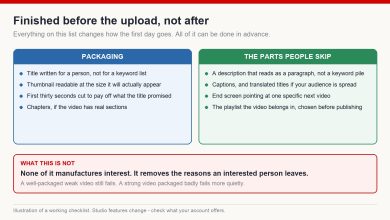
A title that works usually answers at least one of three questions: what will I learn, what problem does this solve, or what makes this worth twelve minutes. “Video Editing Tutorial For Beginners” answers none of them. “The Editing Habit That Was Costing Me An Hour Per Video” answers all three, and it still contains the words somebody would search for.
The searchable words and the reason to click are not in competition. They fit in the same sentence, which is the whole craft of it.
3. Doing the keyword work and skipping the thumbnail
People will spend two hours on research and eight minutes on the image. It is a strange allocation, because the two things are halves of one job.
The title tells someone what the video is. The thumbnail is what makes them stop scrolling long enough to read the title. In search results, on the homepage, in the suggested column – they always appear together and they are always judged together. A precisely researched title under a flat, dark, cluttered thumbnail gets found and then scrolled past, which is a more frustrating outcome than not being found at all.
4. Chasing volume without asking what the person wanted
This is the expensive one, because it wastes an entire video rather than a title.
Search volume tells you how many people typed a phrase. It says nothing about what any of them were hoping to find, and the same phrase almost always hides several different questions.
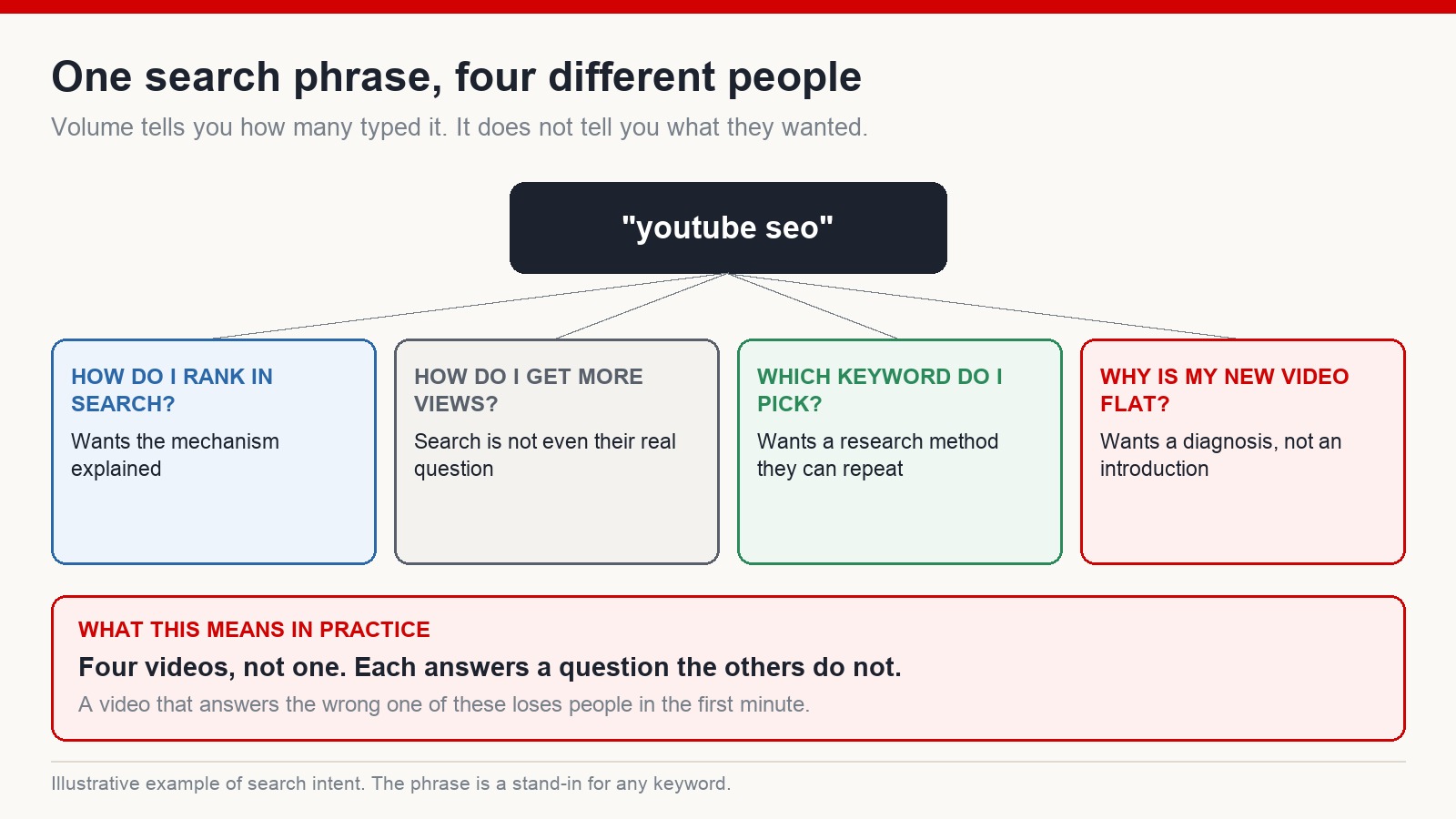
Take a phrase like “youtube seo”. One person wants the mechanism explained – how search results are put together. Another has no interest in search at all and is really asking how to get more views. A third wants a repeatable method for choosing which phrase to target. A fourth has just published something that went nowhere and wants a diagnosis. Four videos, not one, and a video that answers the wrong one of them loses people inside the first minute no matter how well it is made.
The check takes two minutes: search the phrase yourself and look at what is already ranking. The existing results are a rough map of what the platform believes people wanted. If everything on the page is a beginner explainer and you have made an advanced case study, you have not found a gap. You have found a mismatch.
5. Treating it as something you do once
Publish, and move on to the next video. The title written on the afternoon of upload stays there for the rest of the video’s life, including the part of its life where it starts being shown to people the original title was never written for.
Titles and thumbnails are the two pieces of a published video you can revise for free, at any time. A quarterly pass through your older uploads – looking at which ones are being found, which are being found and ignored, and where people are dropping out – is the least glamorous hour in this job and reliably one of the most useful.
What search can and cannot do for a channel
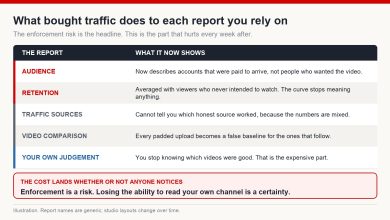
One correction that the usual framing needs. Search is a traffic source, not the traffic source. For a lot of topics, and particularly for faceless channels, the larger share of views arrives from the homepage and the suggested column rather than from anybody typing anything.
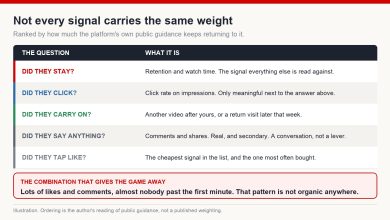
That changes what optimisation is for. Search is how a video gets found by people who already knew they had the question – reliable, steady, usually modest in volume. Being recommended is how a video reaches people who did not know they wanted it, and that is decided by what viewers did after clicking, not by what is written in the description.
So the search work is worth doing, and it is not the growth lever it gets sold as. Check your own traffic sources before deciding how much of your week it deserves.
The question that replaces all five
Every one of these mistakes comes from the same underlying question: what does the ranking system want?
Swap it for a different one. What did this person type, and what were they hoping to find? The platform’s own interest is in people finding something they are glad they clicked and staying to watch it. When you write a title that describes an actual video, pair it with an image that represents that video, and answer the question the searcher actually had, you are not gaming anything. You are doing the thing the system is trying to detect.
Is YouTube SEO still worth doing if most views come from recommendations?
Yes, for two reasons. Search brings steady traffic to videos that answer a specific question, and the same work – clear title, accurate description, honest packaging – is what helps the platform understand and place a video in the first place.
How many keywords should go in a title?
One phrase, used naturally, is plenty. If the title reads like a sentence a person would say, it is fine. If it reads like a list, it is not.
What click rate should I be aiming for?
There is no universal figure, and anyone quoting one is describing their own channel. Track your own and compare each new video against the median of your last ten uploads.
Do tags matter?
Far less than most beginners assume. A handful of accurate ones is sensible housekeeping. Filling the box has never been the difference between a video working and not working.
Should I change the title of a video that is not performing?
If the data points at packaging – it is being shown to people and not opened – then yes, try a different title or thumbnail. Change one of them, wait for the numbers to settle, and read the result before changing anything else.
Where to start
Open your three most recent videos and read the titles as if you had never seen the channel. Ask, for each one, what the person who typed that phrase was actually hoping for, and whether the video gives it to them. That single pass usually finds at least one of the five above.
If you want the rest of the process for building a faceless channel for an English-speaking audience, that is what we work through at mmoyoutube.com. Results vary by topic and channel, and the platform changes – test everything here against your own analytics rather than taking it on trust.